






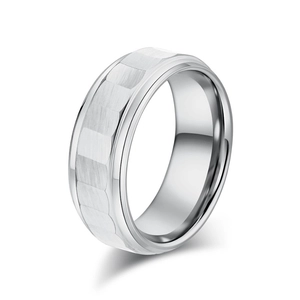
As a jeweler or custom ring seller, do you often face these questions
As a jeweler or custom ring seller, do you often face these questions:
Why do customers give inconsistent sizes? How do you convert between US, UK, and EU ring sizes? Why does the same finger measure differently at different times?
This article answers the most common ring sizing questions and provides an authoritative international size conversion reference.
Q1: What should I tell a customer who asks, "How should I measure my ring size?"
A: Recommend one of the three methods below, and remind them to measure multiple times and take the average:
|
Method |
Instructions |
Accuracy |
|
Professional tool |
Visit a local jewelry store to use a standard ring mandrel – the most reliable method |
⭐⭐⭐⭐⭐ |
|
Existing ring |
Measure the inner diameter (mm) of a ring that fits comfortably, then check the size chart |
⭐⭐⭐⭐ |
|
Paper strip/string |
Wrap a thin strip of paper around the base of the finger, mark the overlap, and measure the length |
⭐⭐⭐ |
Important: Finger size changes throughout the day – morning vs evening, winter vs summer, after exercise vs at rest. Measurements can vary by 0.5–1 full size. Take 2–3 measurements at different times and choose the most comfortable value.
Q2: When a customer says "size 7", do they mean US or UK? What's the difference?
A: This is the most common point of confusion. Different countries use completely different sizing systems:
|
Country/Region |
Size Range |
Characteristics |
|
US/Canada |
#1 – #16 (including half sizes) |
Most commonly used; smaller number = smaller size |
|
UK/Australia |
A – Z (including half sizes) |
Alphabetical order increases with size |
|
Europe |
#40 – #76 (circumference in mm) |
Directly corresponds to inner circumference |
|
Japan/China |
#1 – #30 |
Corresponds to inner diameter (mm) |
Example: US size #7 ≈ UK size N½ ≈ EU size #54 ≈ Inner circumference 54.4mm
Professional advice: Always ask customers for finger circumference (mm) or inner diameter (mm) rather than relying on any country's size code. This is the most error-free communication method.
Q3: Is there a quick reference chart to check US, UK, and EU sizes at the same time?
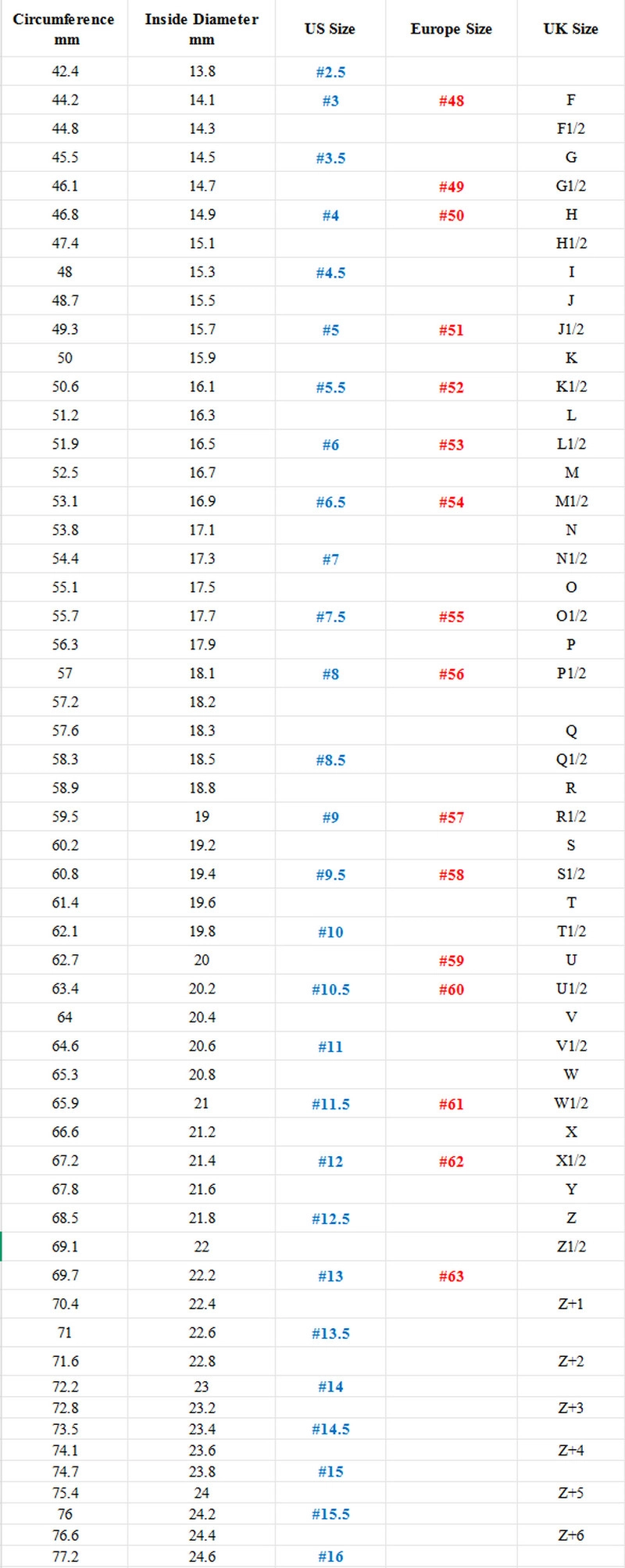
A: Yes. Below is the International Ring Size Quick Reference Chart from QL Jewelry (circumference mm → all major sizing systems):
Q4: Are half sizes really necessary? Customers often ask, "Do you have half sizes?"
A: Absolutely necessary. Especially in the following cases:
Precious metal rings (gold, platinum): Resizing is expensive; half sizes ensure a perfect fit the first time
Wide rings (6mm+): The difference of half a size is very noticeable on wide bands
Wedding rings/couple rings: Worn daily for years; half sizes provide optimal comfort
Industry insight: Approximately 30% of customers ultimately choose a half size. Offering full range of whole and half sizes (e.g., #6, #6.5, #7, #7.5...) can significantly reduce return and exchange rates.
Q5: My customers come from different countries. Is there a universal way to communicate ring size?
A: Yes. The most universal method is to ask for "finger circumference (in mm)" or "inner diameter (in mm)".
Customer communication template (ready to copy and paste):
"To ensure your ring fits perfectly, please measure the circumference of your finger at the base (in millimeters) using a soft tape measure or a thin strip of paper. If you have a ring that fits you well, you can also measure its inner diameter. We will use the millimeter measurement you provide to determine the most accurate size."
Why this works:
Millimeters are a universal unit not affected by different country sizing systems
Avoids fatal confusion like US #7 vs UK #7
Makes it easy to reference against production drawings
Q6: What ring sizing services does QL Jewelry offer?
A: As a professional pure titanium ring manufacturer, we provide the following sizing-related services:
|
Service |
Description |
|
Full size range |
US #4 – #20 (including half sizes) |
|
Wide ring customization |
2mm – 14mm width; size compensation recommendations for wide rings |
|
Bulk order size summary |
Assistance with size distribution analysis to optimize production efficiency |
|
Sample size confirmation |
Sample rings available for size verification before mass production |
|
Multi-label sizing system |
Finished rings can be tagged with US, EU, and UK sizes for easy sorting |
Contact us: Visit www.ql-jewelry.com or email info@ql-jewelry.com for more information.
Summary: Key Takeaways for Ring Sizing
|
# |
Key Point |
|
1 |
Measure multiple times – Take 2–3 measurements at different times of day; choose the most comfortable value |
|
2 |
Standardize the unit – Prioritize millimeters (circumference or diameter) to avoid country code confusion |
|
3 |
Add size for wide bands – For rings 6mm and wider, recommend adding 0.5 size |
|
4 |
Offer half sizes – ~30% of customers need half sizes; this reduces returns |
|
5 |
Clarify the benchmark – For bulk orders, always confirm whether the measurement is centre, leading edge, or trailing edge |
This article is provided by QL Jewelry (www.ql-jewelry.com), a professional manufacturer of pure titanium rings. Please credit the source if republishing.